
n8n's AI-first support strategy that handles 60% of tickets (while growing the team)

Published On
In the past year, n8n has gone from a small support team to hiring 30-plus support engineers. In that same period, AI now handles around 60% of their incoming tickets. Both things are true at the same time, and they are not in tension with each other.
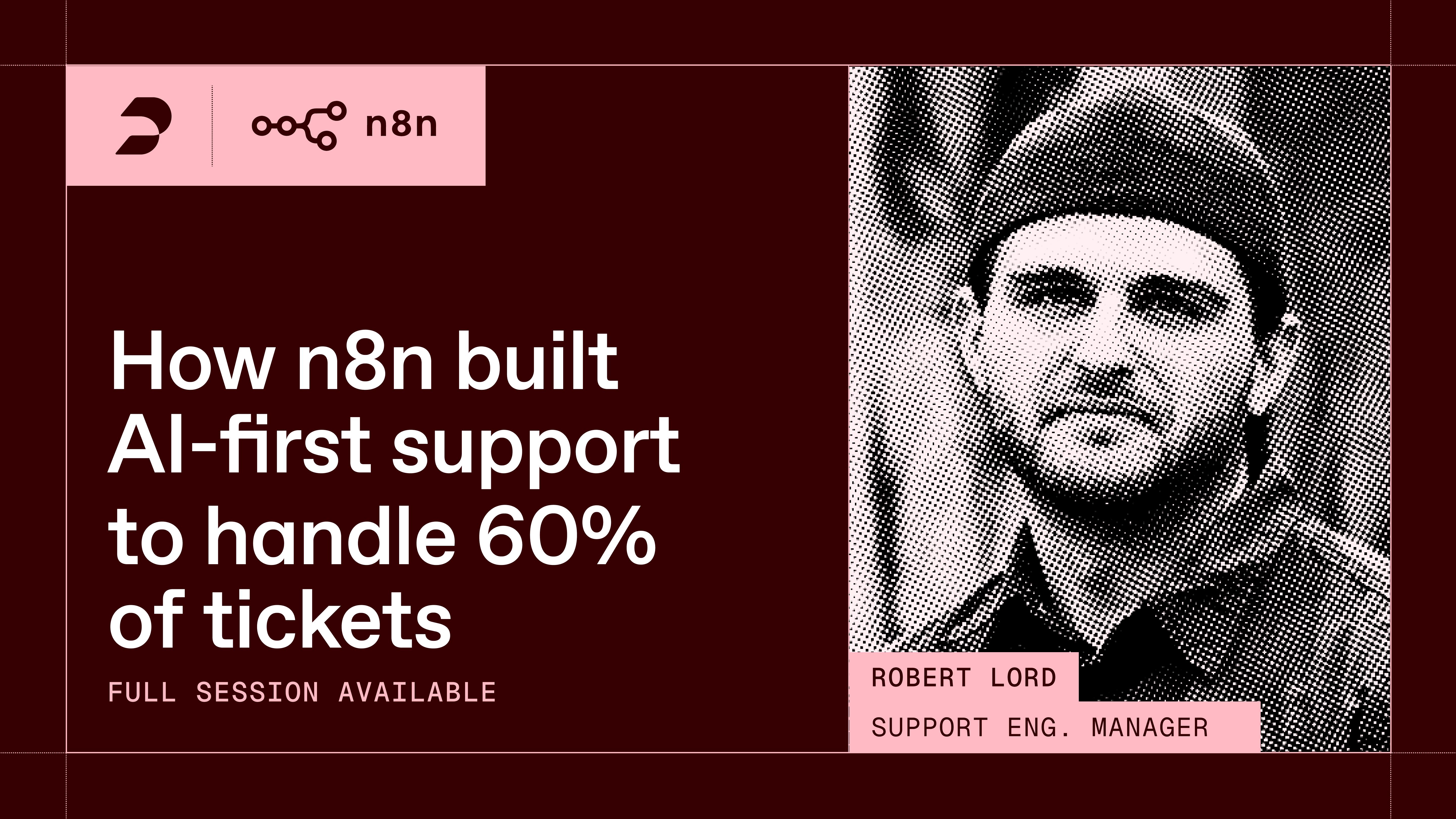
Robert Lord, who manages n8n's support engineering team, joined us to walk through how they built it. He came to n8n as a power user before he was an employee, which gives him an unusual lens: builder, customer, and now the person responsible for scaling the team behind the product.
Here is the framework he shared.
1. Change what your team does, not how many people are on it
Rob's framing is enhancement over replacement. Repetitive tasks get handed off to AI, and the work that remains becomes more demanding in a good way — the team is defining quality standards, shaping how the AI behaves, and handling the problems that actually require judgment.
The bar for what support engineers do every day goes up, not down.
2. Document the process before you automate it
Rob evaluates every automation candidate against three things: what documentation already exists, how often the request appears, and how much risk is involved. Low-risk, high-repetition tasks with solid docs go first. Higher-stakes workflows, like refund processing, only go to AI after extensive testing.
Underneath all of it is process documentation. The AI can only follow guidelines that actually exist, and getting that documentation right has also made onboarding faster as a side effect.
3. Build the audit layer in from the start
Deploying AI without a structured review process is not moving fast — it is just moving without visibility. At n8n, oversight is built into the workflows themselves: KB flags documentation that has not been reviewed in 30 days, Nate surfaces unusual conversations, and there is a structured review process for response quality. When a customer asks to speak to a human, Nate hands off immediately.
Auditing is also a different skill set from doing support. It requires knowing what good looks like before anything goes live, and being willing to hold the system to that standard even when volume is high.
What n8n built on Plain
For a company whose entire product is about connecting anything to everything, their support tool being a black box was not an option. They needed a platform they could actually extend.
Four Plain features ended up being central to how they operate.
The GraphQL API: Plain passes LLM-ready conversation history through the API, so n8n could build their own AI agent without maintaining a separate context database. Every workflow calls it to pull thread data and account state at the moment it is needed.
Intelligent labeling and auto-assignment: Tickets are labeled and routed automatically based on region, priority, and severity. Agents only see their own queue, no manual triaging required.
Multi-channel unified inbox: Email, Slack, and support portal requests all flow into one place. Enterprise customers get dedicated Slack channels; everyone else uses their preferred contact method.
Webhook events for custom reporting: Plain's webhook events pipe into Metabase, giving n8n full visibility through their own dashboards rather than being constrained by built-in reporting.
With the support infrastructure handled by Plain, n8n's team can focus on what Rob spent the whole session talking about: building the AI, auditing the output, and raising the bar on what automated support can actually do.
Watch the full conversation
We run conversations like this regularly. If you want to see how other teams are building on Plain, keep an eye on plain.com/community.
In the past year, n8n has gone from a small support team to hiring 30-plus support engineers. In that same period, AI now handles around 60% of their incoming tickets. Both things are true at the same time, and they are not in tension with each other.
Robert Lord, who manages n8n's support engineering team, joined us to walk through how they built it. He came to n8n as a power user before he was an employee, which gives him an unusual lens: builder, customer, and now the person responsible for scaling the team behind the product.
Here is the framework he shared.
1. Change what your team does, not how many people are on it
Rob's framing is enhancement over replacement. Repetitive tasks get handed off to AI, and the work that remains becomes more demanding in a good way — the team is defining quality standards, shaping how the AI behaves, and handling the problems that actually require judgment.
The bar for what support engineers do every day goes up, not down.
2. Document the process before you automate it
Rob evaluates every automation candidate against three things: what documentation already exists, how often the request appears, and how much risk is involved. Low-risk, high-repetition tasks with solid docs go first. Higher-stakes workflows, like refund processing, only go to AI after extensive testing.
Underneath all of it is process documentation. The AI can only follow guidelines that actually exist, and getting that documentation right has also made onboarding faster as a side effect.
3. Build the audit layer in from the start
Deploying AI without a structured review process is not moving fast — it is just moving without visibility. At n8n, oversight is built into the workflows themselves: KB flags documentation that has not been reviewed in 30 days, Nate surfaces unusual conversations, and there is a structured review process for response quality. When a customer asks to speak to a human, Nate hands off immediately.
Auditing is also a different skill set from doing support. It requires knowing what good looks like before anything goes live, and being willing to hold the system to that standard even when volume is high.
What n8n built on Plain
For a company whose entire product is about connecting anything to everything, their support tool being a black box was not an option. They needed a platform they could actually extend.
Four Plain features ended up being central to how they operate.
The GraphQL API: Plain passes LLM-ready conversation history through the API, so n8n could build their own AI agent without maintaining a separate context database. Every workflow calls it to pull thread data and account state at the moment it is needed.
Intelligent labeling and auto-assignment: Tickets are labeled and routed automatically based on region, priority, and severity. Agents only see their own queue, no manual triaging required.
Multi-channel unified inbox: Email, Slack, and support portal requests all flow into one place. Enterprise customers get dedicated Slack channels; everyone else uses their preferred contact method.
Webhook events for custom reporting: Plain's webhook events pipe into Metabase, giving n8n full visibility through their own dashboards rather than being constrained by built-in reporting.
With the support infrastructure handled by Plain, n8n's team can focus on what Rob spent the whole session talking about: building the AI, auditing the output, and raising the bar on what automated support can actually do.
Watch the full conversation
We run conversations like this regularly. If you want to see how other teams are building on Plain, keep an eye on plain.com/community.