
How Stytch's Johanan Lai Turns Customer Noise Into Signals Engineers Can Act On

Published On
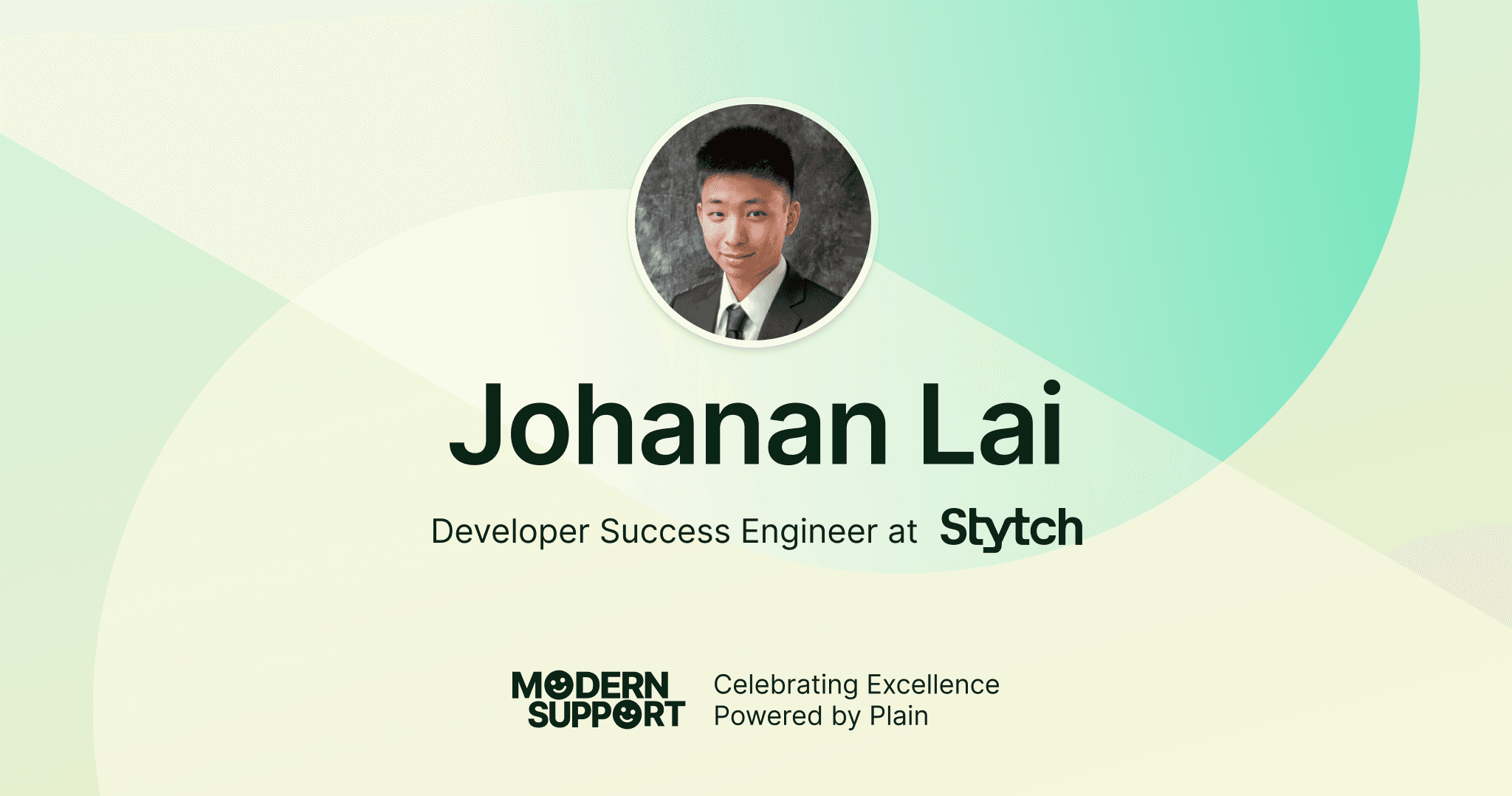
Johanan Lai is a Technical Support Engineer 3 at Stytch (a Twilio company) and a 2025 Modern Support Award winner.
We created these awards to recognize individual contributors who are shaping the future of customer support — people who build solutions, not just close tickets.
Stytch runs their support on Plain. Johanan's work is exactly what these awards are meant to celebrate: he effectively translates customer feedback into product signal.
The Habit That Changes Everything
Johanan Lai has a rule: never copy-paste a customer message to engineering.
It sounds small, but the impact is huge.
When a frustrated customer sends a wall of text about their authentication integration breaking, most support engineers would forward it along with a quick summary. Johanan does something different. He reads the message, understands the underlying issue, and rewrites it from scratch.
"Don't paste the entire mess customer message, but don't also write a one-liner that doesn't really clarify the issue. Something that's short and sweet, but also covers whatever the use case issue might be."
This habit isn't about being tidy. It's about making everyone else faster. When Johanan sends a summary to the product team, they can act on it in seconds instead of parsing through layers of frustration and technical detail.
The result is more than cleaner communication. It's a translation.
What the Rewriting Reveals
The translation habit is a window into how Johanan processes information. He doesn't relay signals. He refines them.
His manager Christopher O'Neill describes the result: "His work is the backbone that makes customer conversations smarter, product decisions sharper, and technical solutions more reliable here at Stytch."
That backbone isn't built from superior product knowledge, though Johanan has that too. It comes from a specific way of thinking: every customer interaction contains raw material that needs processing before it can travel.
The rewriting is where that processing happens. Every customer message becomes a small act of translation, turning noise into signal for the people who need to act on it.
Learning to See From the Customer's Side
Johanan came to tech naturally. Much of his family works in the industry, and computer science felt like a continuation rather than a discovery. "Even now, sometimes if I have dinner with family, our dinner chats are just nerdy stuff," he says.
He studied computer science, but his path into support came almost by accident. After graduation, he was job hunting and found an opportunity at Datadog when the company was still small. He stayed six years, reaching staff level and watching the company go through its IPO.
What he learned there couldn't have been taught in a classroom. "A lot of things you learn in school are really low level," he says. "It's one thing to understand data structures and algorithms. It's another thing to understand, 'Hey, we want to spin up our service in Kubernetes and make sure it can scale based on needs.' Those are things that they don't really teach you."
He took a break after Datadog, then joined Stytch earlier last year where he helps Developers be successful with the product.
The Assumption He Had to Unlearn
Early in his career, Johanan operated from a default position: when a customer complained, they were probably wrong.
He's honest about it. "You kind of start with the assumption that the customer is wrong sometimes.”
But that assumption cracked over time. He started noticing that even frustrated, confused customers often identified real gaps — even when their overall understanding was off.
At Stytch, where developers are integrating authentication, this shift matters. Johanan recalls a common type of feedback: "We're trying to set up auth, but I'm not trying to learn auth just to use Stytch." He takes that seriously now. The customer may not understand the product perfectly. But their frustration points to something real: documentation that could be clearer, an example app that could help, a gap that internal experts have been blinded to.
"What can you do to improve the product experience or their experience — whether that's an example app, snippet, improving the docs, clarifying stuff so that they don't trip up on something that from the Stitch side, we might find obvious? But for them, maybe it's not."
He calls this empathy. He also calls it a work in progress. "It's something I haven’t been the greatest at, but I think I've gotten better. And hopefully, I'll continue to get better."
Spotting What Others Miss
His manager Chris O'Neill highlighted a specific skill: "He anticipates edge cases most wouldn't think to check."
Johanan doesn't have a clean explanation for this. But the behavior is consistent with everything else about his approach. He doesn't skim customer problems. He doesn't assume he understands before he does. He builds what his manager calls "an airtight understanding of how everything works together."
That depth lets him see problems before they escalate. Chris puts it plainly: "He equips the team with precise insights, anticipates edge cases most wouldn't think to check, and consistently uncovers the details that elevate the Stytch customer experience from good to exceptional."
Teaching Others to Fish
When asked what he tells people joining technical support roles, Johanan's answer is simple: absorb everything.
"Try to be a sponge and absorb as much knowledge as you can. Just sit in office hours and listen. You don't have to ask any questions, but just be a fly on the wall.”
This isn't abstract advice. At the end of his time at Datadog, he spent time working with new hires. He gave them the same advice he still believes in.
And beyond listening, he recommends getting hands-on early. "Read through some of the internal docs, run through a demo yourself. The sooner that you feel comfortable using your own product, the more likely you'll be in a good position to understand what kind of questions or issues a customer might be running into."
This is also how Johanan still operates. Even though he’s been at Stytch for a while, he's still absorbing, still running demos, still asking questions.
What Sets Johanan Apart
What makes Johanan effective isn't just depth. It's how he shares what he knows. Here's what that looks like in practice:
Rewrites instead of forwarding. Every customer message gets translated into something teams can act on immediately.
Builds airtight system understanding. He doesn't settle for surface-level familiarity. He maps how everything connects
Grew his own empathy. He recognized that assuming customers were wrong was limiting him, and deliberately shifted his approach.
Catches edge cases early. His depth lets him see problems others would miss until they escalate.
Stays in learning mode. He still describes himself as making mistakes and absorbing knowledge.
Invests in teaching. His goal isn't to be the expert everyone depends on. It's to help others become self-sufficient
These skills weren't given to him. He built them over the years and continues to invest on them now.
The Signal in the Noise
Somewhere today, a customer will send a confusing message about an authentication integration that isn't working. It will be long. It will mix frustration with technical details. It will be hard to parse.
Johanan will read it. He'll understand the real issue. And he'll rewrite it.
Not because anyone told him to. Because that's how he thinks. Turn noise into signal. Make the conversation smarter. Help the team make better decisions.
One rewritten message at a time, the whole organization gets a little bit sharper.
—
Plain builds customer support software for teams like Stytch's — for support professionals who want to prevent problems, not just close tickets.