
How Turn.io's Raquel Graça Went From Journalist to Support Strategist

Published On
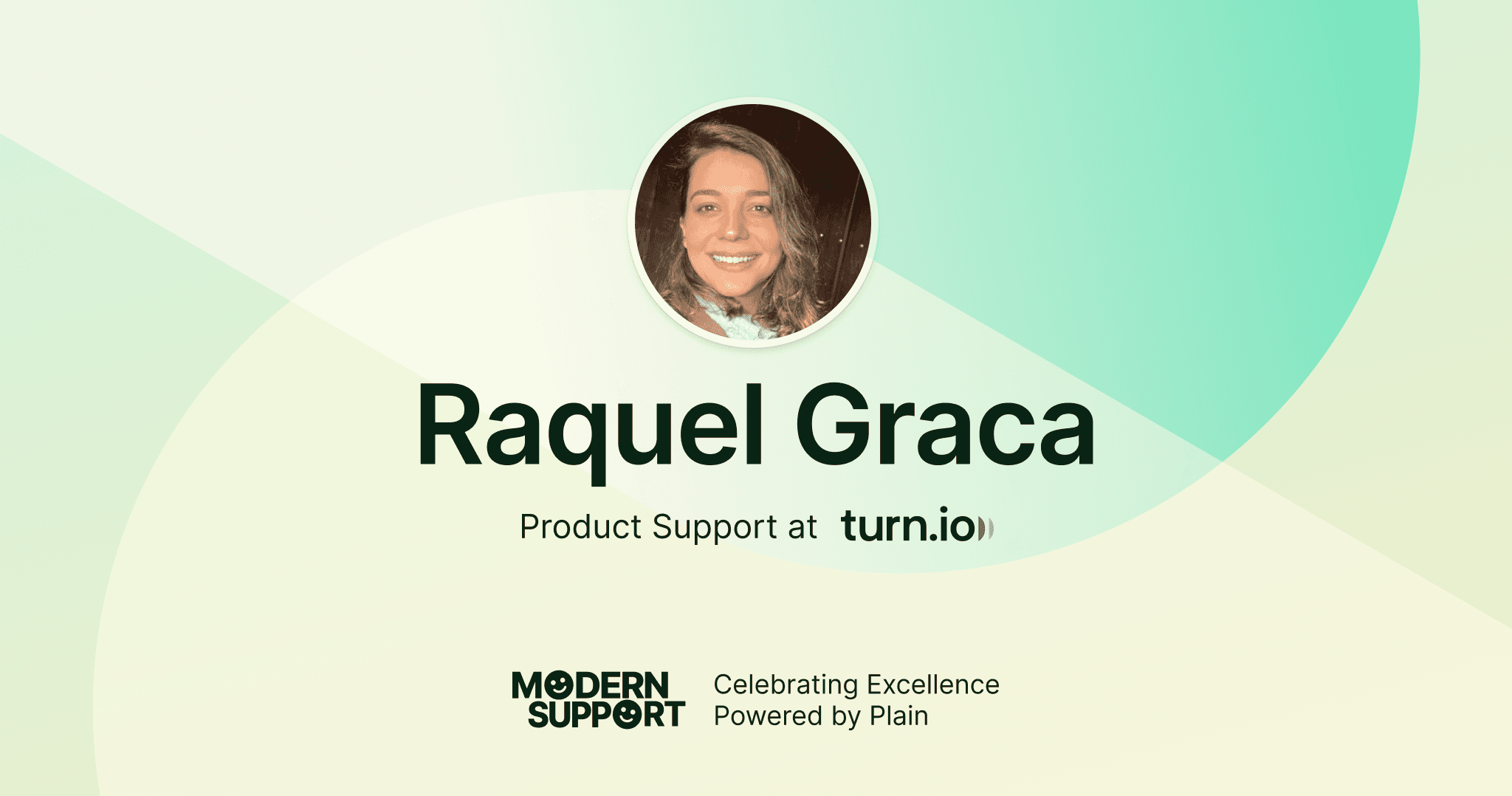
Raquel Graça is a Support Specialist at Turn.io, and a 2025 Modern Support Award winner.
We created these awards to recognize individual contributors who are shaping the future of customer support — people who build solutions, not just close tickets.
Seeing Problems Before They Arrive
Raquel doesn't think of support as a queue. She thinks of it as a system.
At Turn.io, she describes her role as being "the bridge between customers and technology." That framing shapes everything she does. Bridges aren't built once traffic piles up. They're designed in advance to handle what's coming.
That mindset is what led Raquel to take ownership of Turn.io's knowledge base.
When she looked at the help center, she saw something that didn't align with her definition of support: articles that were hard to find, outdated, or unclear — forcing customers to open tickets for answers they should have been able to find themselves.
"When they say you are on support, and this is your mission," Raquel explains, "then articles and tutorials are also related to that mission.”
So she acted.
Raquel reorganized categories, simplified article titles, hid outdated content, and rebuilt the structure so customers could actually navigate it. The result wasn't just a cleaner help center — it was a measurable reduction in inbound support volume, because customers could finally solve problems on their own.
A Career That Trained Her to Ask "Why"
Raquel's ability to see the bigger picture didn't start in tech.
She spent twelve years as a journalist in Brazil, working in enterprise communications, publicity, and marketing. She was great at it, but part of the job slowly drained her.
"I was doing budget control for publicity, and it was so stressful," she says.
At the same time, she was given a side project: coordinating the launch of the company's first ecommerce platform. That work meant talking to developers, designing workflows, and understanding how systems fit together.
She noticed the contrast immediately.
The budget work exhausted her. The ecommerce work energized her.
And so she made the decision that changed everything. She enrolled in Le Wagon, a European web development bootcamp.
"I was like, oh my god — I can build this," she says. "I don't need to only fill it with content and text. I can actually build a page, do some logic, see the backend."
Le Wagon's slogan is "Learn to code, change a life." For Raquel, that was very true.
Prevention Is the Real Work
Most support teams are structured to react. A customer hits a problem. A ticket comes in. Someone responds.
Raquel works upstream from that.
She follows Turn.io's product roadmap closely. Not out of curiosity alone, but to anticipate what customers will struggle with next.
She thinks in chess moves — three to six months ahead — adjusting her work before volume spikes or confusion appears.
It's this prevention-first mindset that makes her impact compound. Customers get answers faster. The team handles fewer repetitive questions. Support becomes a strategic function, not just a response mechanism.
Recording Anyway
Raquel's ownership doesn't stop at written documentation.
When her team asked if she could record video tutorials — often easier for customers to follow than text — her first reaction was fear.
"I didn’t want to do it at first. I'm so self-conscious to be in a video and talking to people."
She did it anyway.
Raquel built Turn.io's YouTube tutorial library, recording take after take until each video was clear and accurate. She continues updating them as the product evolves — extending the reach of support far beyond the inbox.
"I'm proud of challenging myself to do that," she says. "To record the videos, create tutorials, and build a little bit more reach for our customers."
The pattern is consistent: see what needs doing, acknowledge the discomfort, do it anyway.
AI Isn't Optional, It's a Responsibility
Raquel doesn't see AI as a threat to support. She sees it as inevitable — and something support teams have a responsibility to shape thoughtfully.
"There is an important role for AI in support," she says. "We cannot just skip that. If we do the old style, we will lose the opportunity to be more efficient."
She's heard it directly from customers. At Turn.io community events, the message was clear: "We want an AI to interact with."
Some customers don't want to wait. They want fast answers to simple questions. AI can handle that — freeing humans to focus on complex, high-stakes problems.
Raquel is currently building the AI strategy for her team, consolidating articles into Plain's customer portal to create a strong knowledge foundation for an AI assistant.
Just as importantly, she's thinking carefully about boundaries: what AI should handle and what must remain human.
"Don't Be Afraid of the First Barrier"
When asked what advice she'd give to support professionals facing an uncertain future, Raquel doesn't hesitate.
"Don't be afraid of the first barrier. I thought I wasn’t capable of learning these concepts because of my non-technical background."
She used to see technology as a "little monster." Coming from journalism and languages — not engineering or mathematics — she assumed technical work wasn't for her.
She was wrong.
"Being scared should not be a barrier," Raquel says. "You should go beyond the things that scare you. Challenge yourself. You might get surprised at the end."
AI, she believes, isn't coming to replace support professionals. It's coming to amplify the ones willing to adapt.
What Sets Raquel Apart
Her manager Krishna puts it simply:
"Raquel is consistently diligent, thoughtful, and proactive. Her contributions have directly reduced inbound support volume by enabling customers to quickly find answers on their own. Rather than focusing solely on resolving the immediate issue, she works to identify the underlying cause and implement solutions that prevent the issue from recurring."
That impact comes from a specific set of skills — ones any support professional can build:
Prevention mindset. Solving problems before customers feel them.
Ownership beyond the job description. Seeing the knowledge base as part of the mission.
Strategic anticipation. Tracking the roadmap to prepare for what's next.
Willingness to be uncomfortable. Recording videos, learning new tools, speaking up.
Big-picture thinking. Connecting communication, product, and technology.
Continuous learning. From programming to AI strategy.
These aren't innate traits. Raquel built them step by step — by choosing responsibility over comfort, and prevention over reaction.
The first barrier, it turns out, was never as high as it looked.
—
Plain builds customer support software for teams like Turn.io's — for support professionals who want to prevent problems, not just close tickets.