
"Build it, don't just run it"
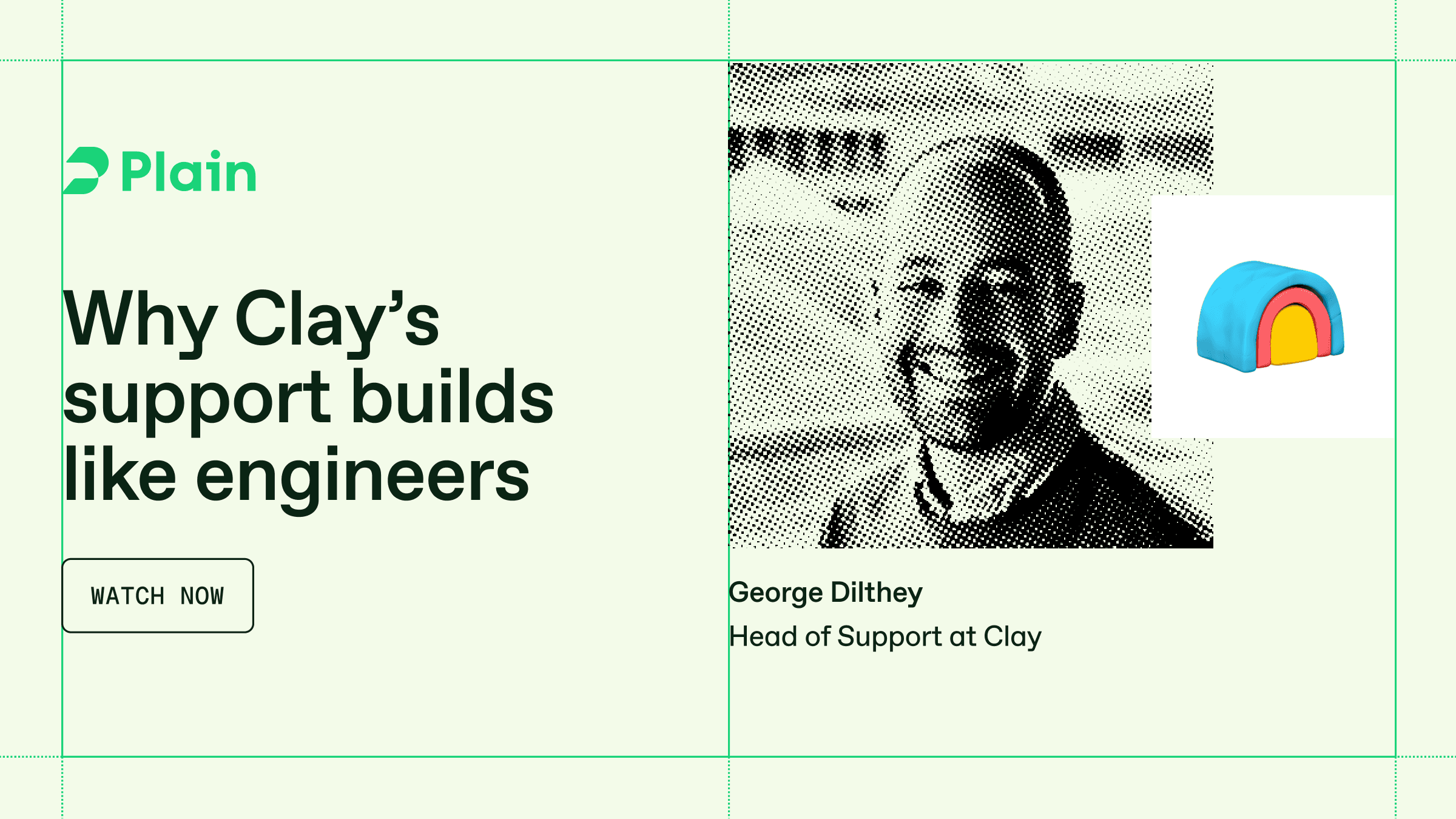
A conversation with George Dilthey, Head of Support at Clay
George Dilthey leads Support at Clay, a workflow automation platform for go-to-market teams. He started his career in the arts world and marketing analytics before falling into support at Mutiny and hasn't looked back since.
This is a ~30 minute conversation about what happens when you build a support team from scratch at one of the fastest-growing companies in tech: hiring new grads, rotating them through the company, navigating AI deflection, and staying obsessed with customer outcomes even as everything around you changes.
What I loved about our conversation
The Wheel is a talent engine, not just a rotation program. New grads start in support full-time, become product and customer experts, then rotate 70/30 across the company. The result: "support alumni" embedded in every team, carrying the customer voice with them. George gets three DMs a week from leaders asking for a Wheelie.
First contact resolution flipped on its head. George used to chase high FCR as a quality signal. Now he sees it the opposite way: if a human can solve it in one shot, AI should probably be handling it. Dropping FCR for humans actually means the team is doing the harder, more consultative work.
Response times are a customer experience decision, not an efficiency metric. Clay doesn't measure response times in seconds. They go into headcount conversations starting with the experience they want (one to two hours), then figure out what they need to maintain it. Not the other way around.
"You should just build." George was feeling guilty about getting into the weeds instead of doing "leadership things." His boss Jess told him to block time to build. Now he's back to shipping Fin automations, Notion agents, and workflows and pushing that same mentality across the team.
Jump to a section:
[00:00] George's path from cello and Lincoln Center to support leadership. "I didn't really know what support was"
[03:45] Building the team from 3 to 30, and why Clay's co-founders committed to support as a value driver, not a cost center
[05:30] The Wheel program. How new grads rotate through the company and become "ambassadors for customers"
[08:15] What great support looks like at Clay. Supporting both workflow beginners and seasoned rev ops leaders
[10:45] The AI frontier. Using Intercom's Fin, and why the questions that reach humans keep getting harder
[13:00] Support and success merging at the enterprise level. "That line starts to get very thin"
[15:20] Why Clay doesn't chase fast response times, and how they goal the team around customer experience instead
[17:30] First contact resolution, reimagined. "Anything that can be answered in one shot probably should be answered by AI"
[19:00] Better customer outcomes as the North Star, and the problem of not knowing if AI actually solved the problem
[21:45] Trust boundaries with AI. Why enterprise customers don't see Fin, and where humans still matter
[24:00] The builder mentality. "If you're answering the same question three times a day, we have to figure out how to automate that"
[26:30] What he'd do differently from zero. Getting engineers to document features in plain text so AI can use it downstream
[29:00] Parting advice: build with AI in mind, but never lose sight of the customer experience
[30:30] Clay is hiring in SF, New York, and London. clay.com/careers