
Meet Sidekick


Published On
A customer question is rarely answered from the conversation alone.
Before anyone replies, someone checks whether engineering already fixed the issue, digs up a promise made months ago, and confirms the customer’s plan — pulling context from issue trackers, observability tools, docs, product analytics, and the CRM. Gathering it takes longer than writing the reply.
Sidekick is how we think you solve that.
Reduce your investigation time to 0
Sidekick is an AI agent built into Plain that has access to all your support threads and every tool you connect, then investigates, drafts, triages, and reports on its own.
We originally built it for use inside support threads — but then customers started asking it broader questions.
“Is this bug fixed yet?”
“What changed overnight?”
“Which customers are affected by this incident?”
“Which feature requests came in this week, and how much revenue is behind them?”
Each is a single prompt that needs information from many systems before anyone can reach a conclusion. We started calling that an investigation.
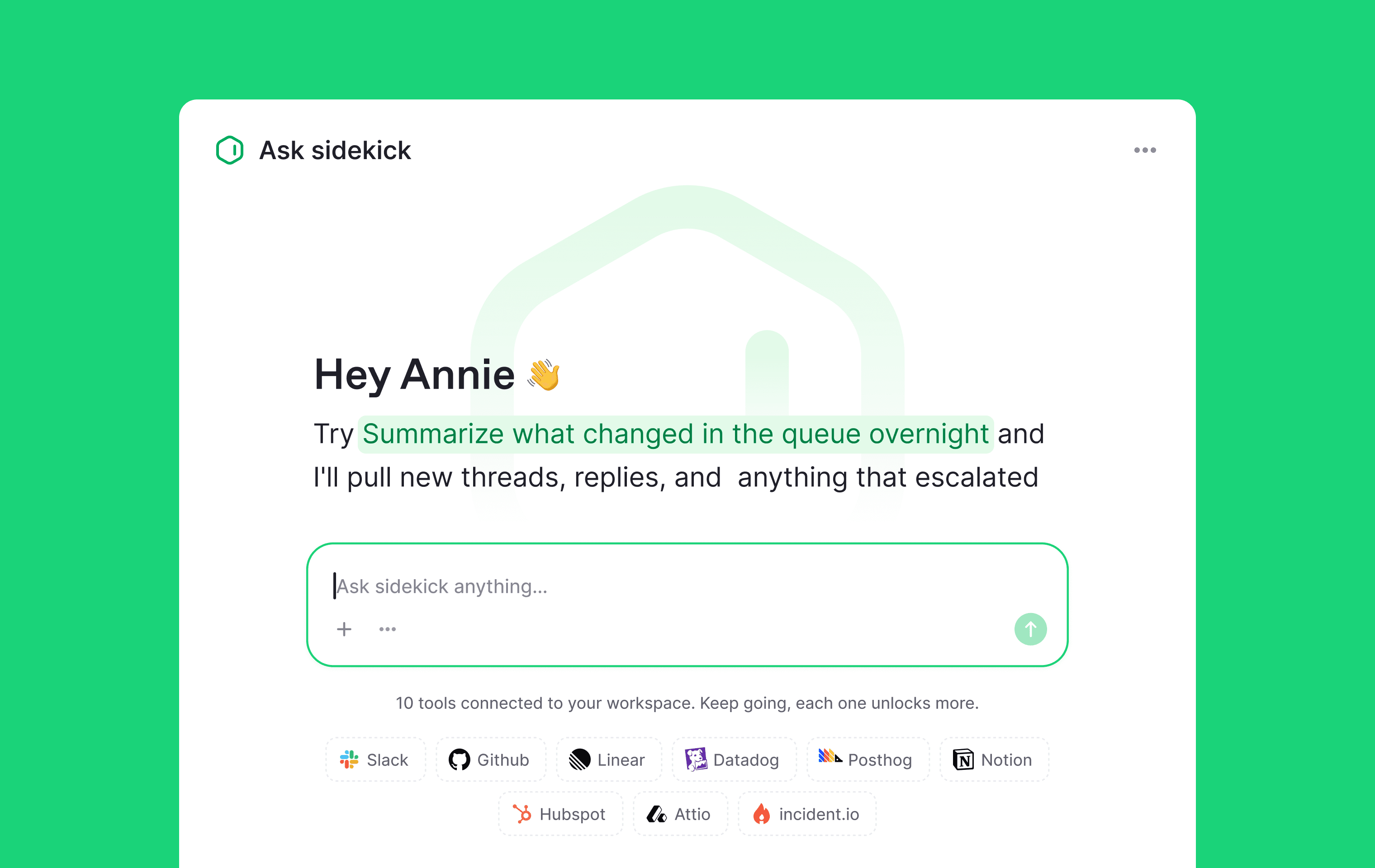
An investigation starts with a question. Sidekick gathers context from conversations, engineering systems, docs, and connected tools, reasons across what it finds, drafts a conclusion, and asks for approval before any action that affects customers or external systems.
Connect to all of your tools
Plain is Sidekick’s home, and it connects to all the tools you already use:
Notes and docs — Notion, Grain, Granola
Deals and accounts — HubSpot, Attio
Issues and incidents — Linear, Jira, incident.io
Errors and production signals — Datadog, Grafana, Sentry
Product behavior — PostHog, LaunchDarkly
Plus Slack and read-only access to your codebase on GitHub
If you’ve built your own internal tooling, connect it through a custom MCP server. The more you connect, the more Sidekick can do.
See it at work while you stay in control
Reading is only half the job. Safe, reversible actions happen automatically: adding an internal note, linking a thread to a Linear or Jira issue, drafting a reply, updating a help center article.
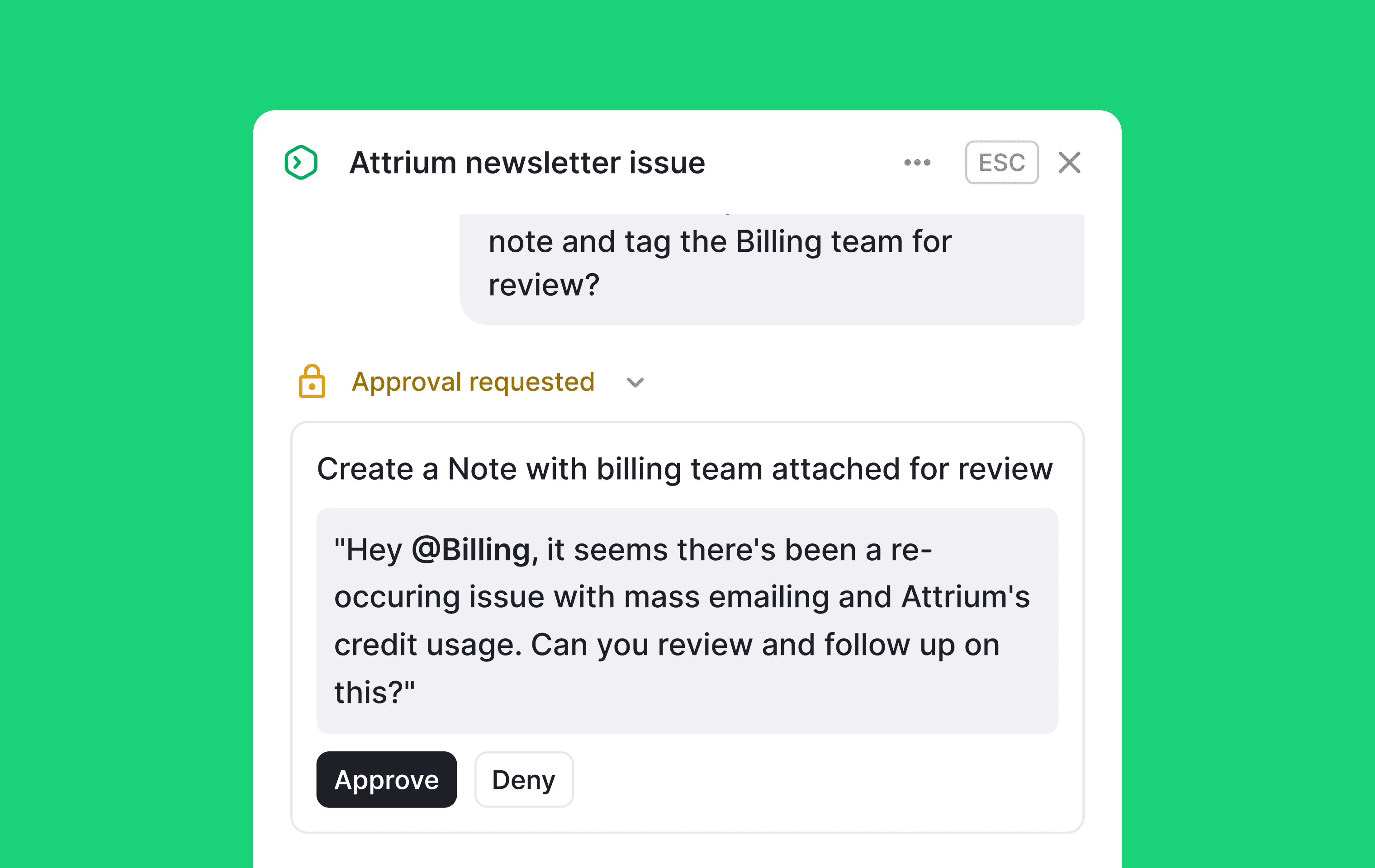
Anything higher-stakes needs a human to approve it first, like merging threads or a write to an external system that can’t be undone. That gate isn’t a setting someone can forget to turn on; it’s built into how Sidekick works. It proposes, drafts, and prepares. Your team stays in control of anything that matters.
Schedule autonomous tasks
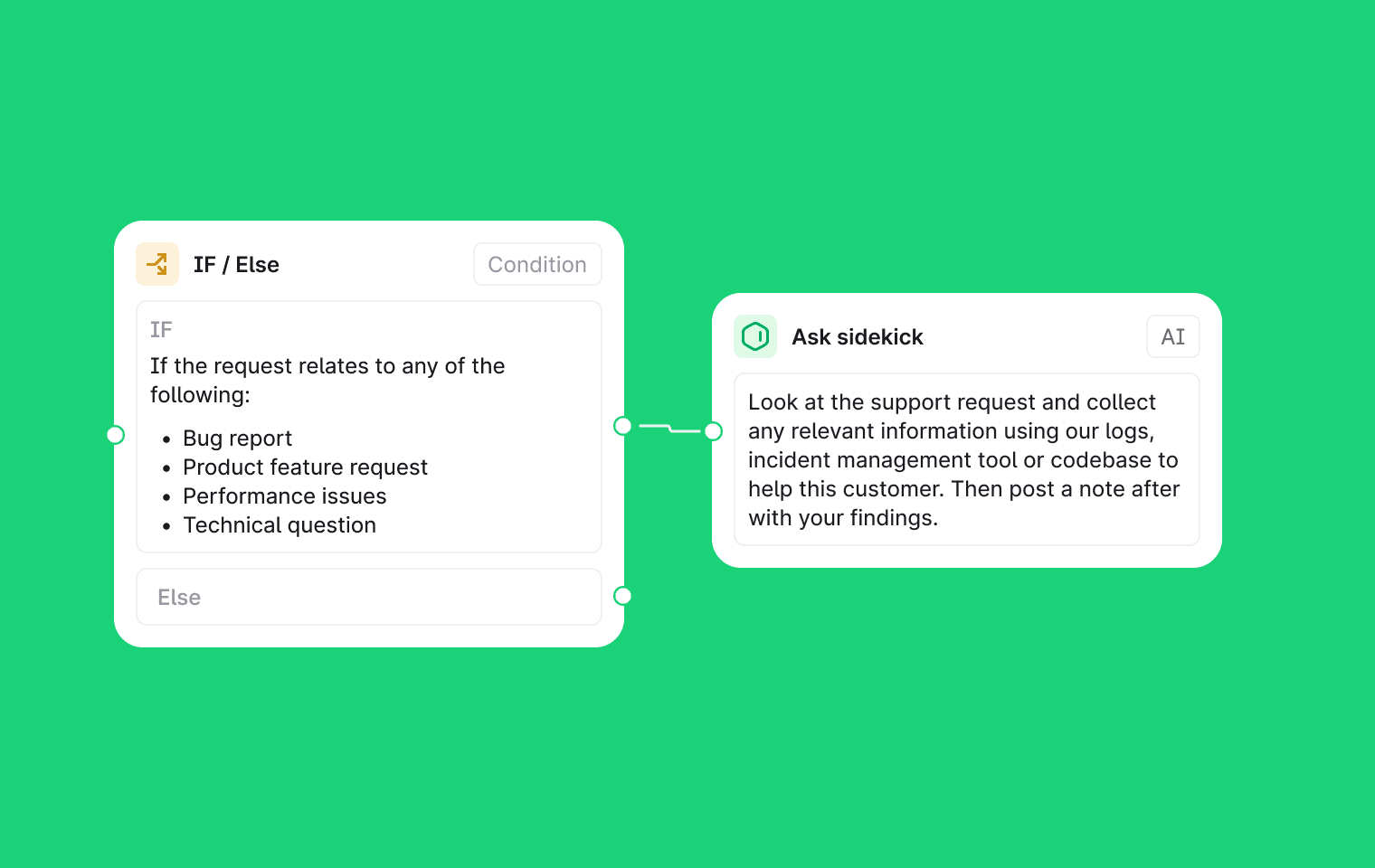
Sidekick doesn’t wait to be opened. It can run on its own, triggered by your queue or by a schedule:
An enterprise customer reports they can’t do something. Sidekick automatically checks their plan, the relevant feature flags, and recent code changes, then posts a note explaining what it found.
Several threads raise the same issue. Sidekick checks whether there’s an active incident, links the threads to it, and flags the pattern before it turns into a bigger problem.
A workflow runs on a schedule. Every Friday, Sidekick reviews the week’s threads, groups the recurring questions, and flags where your help center is missing an answer — before anyone asks.
Run many investigations in parallel
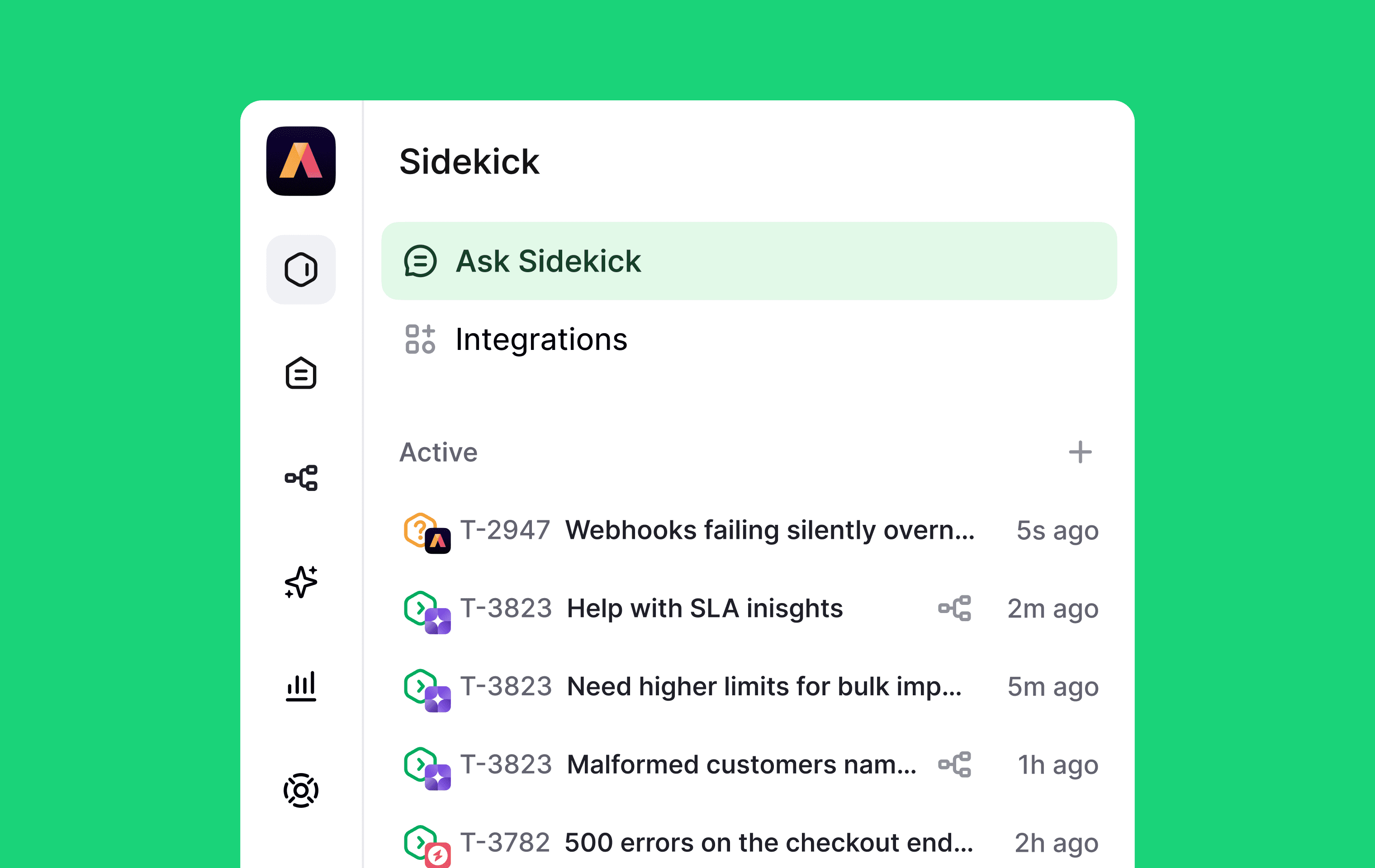
Every Sidekick session shows up in one shared workspace with live status, pending approvals, and finished results, whether it came from a thread, from Slack, from a workflow, or from a scheduled run.
Your team can move between investigations without losing context and run many at once. Ask “what needs my attention right now?” and Sidekick pulls your SLA breaches, oldest open threads, and anything that escalated overnight, across the whole queue.
It’s where Sidekick stops being something you open on a single ticket and becomes something your team works alongside.
Where support work is heading
Sidekick represents the first step in the direction of where we think support is heading.
We envision a future where everyone working in support has their own Sidekick — one that thinks like they do, works like they do, and has access to the tools they use. We’re bringing support towards a world where the unit of work is no longer the ticket you work on, but the agents you work with and the systems you’re able to build with them.
We’ve been using Sidekick across our own team for a while now, and the shift is already visible. Marketing uses it to understand customer feedback before launches. Product explores patterns across support conversations. Support engineers spend less time hunting for background, because the investigation already brings the context together. What stays with people is the judgment: communicating with customers, weighing priorities, deciding when an exception is warranted. Those decisions get easier when the investigation is already done.
Most AI tools have been trained on the general idea of support. Sidekick works on yours (your customers, your product, your incidents, your contracts) and gets more accurate as your workspace grows, not less.
Support work has outgrown the single thread it used to live in. Sidekick is built for what comes next.
Watch the full tour:
Watch Video
4:19
Start your first investigation
Sidekick is enabled by default on every paid Plain plan. Open the new Sidekick page in your workspace to connect your tools, manage integrations and skills, and ask your first question.
Usage is priced using credits, which measure how much your team uses Sidekick across your workspace. Every Plain plan includes a monthly credit allowance that resets at the start of each billing cycle. If you need more, you can buy add-on credits at any time, and those roll over from month to month.